
Looking to partner with merchants or affiliates to promote products? An affiliate marketing agreement forms the basis of this relationship.
This contract spells out how an affiliate will market a merchant’s products and earn commissions for successful referrals.
This agreement protects both the affiliate and the merchant by clearly defining payment terms, promotion rules, and each party’s responsibilities. Without one, you might face payment issues, unclear expectations, or sudden termination.
Whether you create content or sell products, understanding these agreements helps you build solid partnerships while protecting your business interests.
That’s why, in this guide, I’ll talk about all you need to know about affiliate marketing contracts and agreements.
Disclaimer: If you buy any products through links on this site, I may earn a commission. But it doesn't make any difference to your cost, and it helps me keep this blog running. So you could always read my articles for free.
What is an affiliate marketing agreement?
An affiliate marketing agreement is a legal contract between an affiliate and a company (the merchant). This document sets the rules for how the affiliate will promote their products and earn commissions.
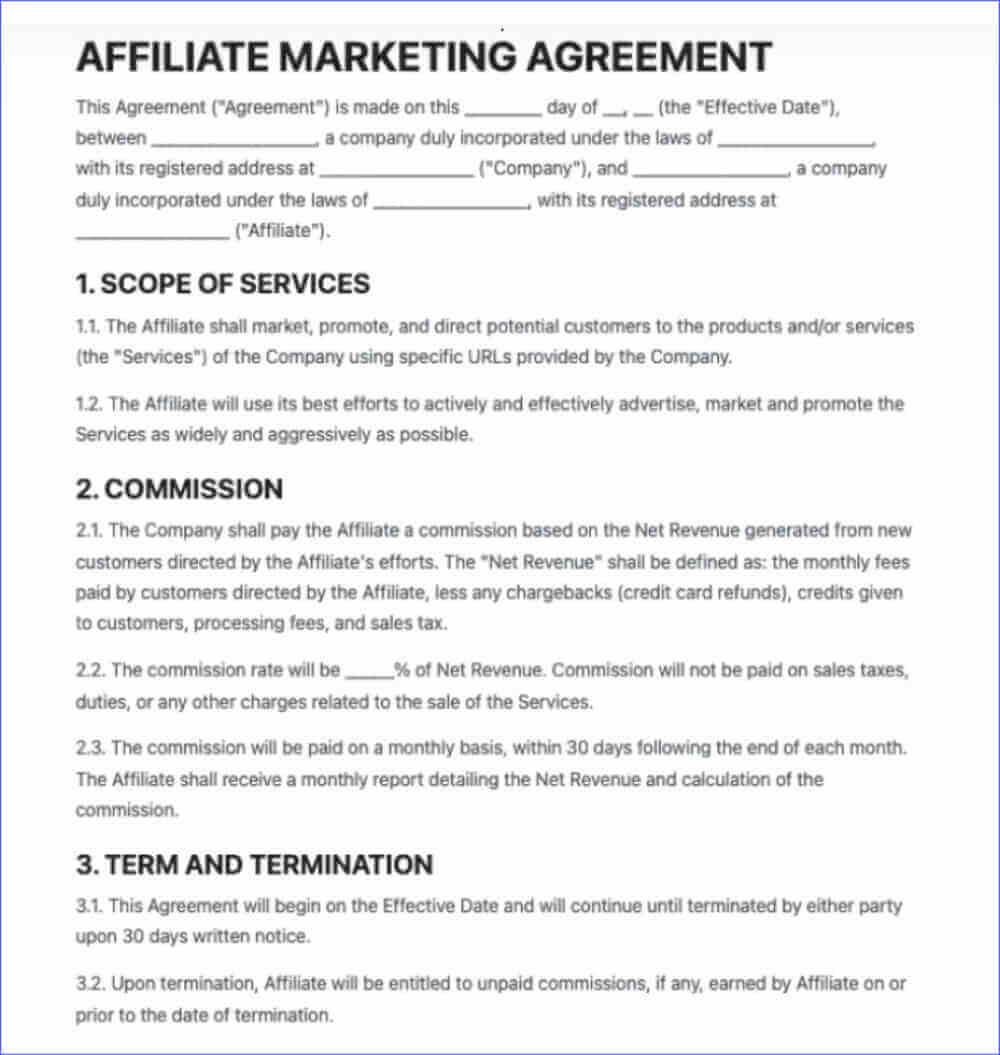
The affiliate marketing contract typically covers how much will be paid per sale or lead, when and how the affiliate gets paid, and what promotion methods can be used.
For example, if you run a fitness blog, your agreement with a protein powder company might specify that you earn 15% of each sale made through your custom link, with payments sent monthly when you reach $100 in commissions.
Besides that, the agreement also protects both parties. It prevents misunderstandings about payment terms and sets clear expectations about what the affiliate can claim about the products.
Some affiliate marketing agreements even include non-compete clauses that limit your ability to promote competing products.
By understanding each section of your affiliate agreement, you can avoid surprises and build a sustainable income stream through ethical promotion.
Why use an affiliate marketing contract
Using an affiliate marketing contract protects both you and your business partners. Without this written agreement, you’re working on trust alone, which can lead to problems when money is involved.
A proper contract clearly states how much commission you’ll earn and when you’ll get paid.
For example, instead of a vague promise like “we’ll pay you for referrals,” your contract might specify “15% commission on each sale, paid monthly via PayPal.”
Besides payment terms, affiliate marketing agreements also outline what you can and cannot say when promoting products. This helps prevent misleading claims that could damage the merchant’s reputation or even lead to legal issues.
Take the case of health products. Without clear guidelines, an affiliate might make unapproved medical claims that could get both parties in trouble with regulators.
Another benefit is having defined terms for ending the partnership. This means you won’t suddenly lose access to your affiliate links without warning, and merchants won’t have their products promoted in ways they didn’t approve.
Here’s what makes these contracts truly valuable: they transform casual arrangements into professional business relationships.
With everything in writing, you can focus on creating great content and promotions rather than worrying about payment disputes or changing rules.
In short, an affiliate marketing contract gives you clarity, security, and a foundation for long-term success.
What to include in an affiliate marketing agreement?
Creating an affiliate marketing agreement requires careful attention to several key elements.
This document will guide your affiliate relationships and prevent misunderstandings, so it’s worth taking the time to get it right. Let’s explore the essential components you should include.
Basic information and definitions
Start your agreement with the names and contact information of both parties – you (the merchant) and your affiliate.
This section should clearly identify who’s who in the relationship. Include the effective date of the agreement and define any technical terms you’ll use throughout the document.
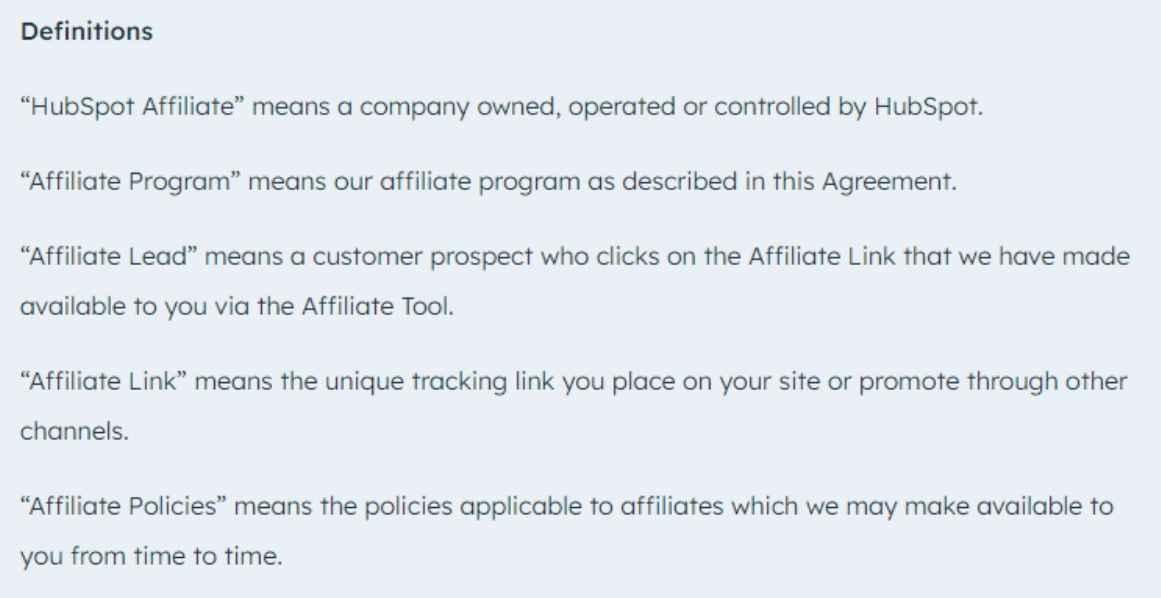
For example, you might need to define terms like “qualified referral,” “tracking link,” or “cookie duration” in the affiliate marketing contract. So, both parties understand exactly what these mean in the context of your program.
Commission structure
This section forms the heart of your affiliate marketing agreement. Clearly spell out how much you’ll pay affiliates and for what specific actions. Will you pay per sale, per lead, or per click? What percentage or flat rate will you offer?
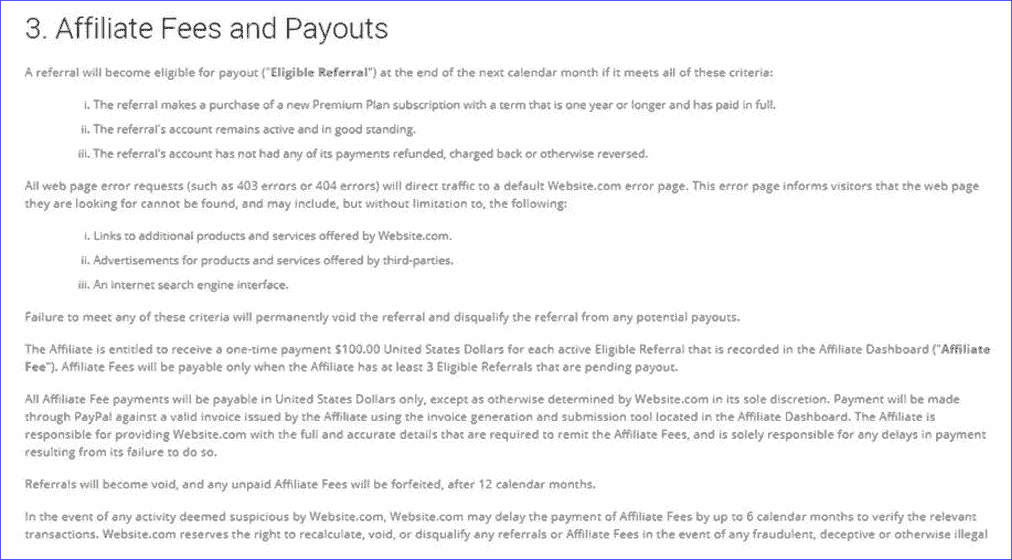
Let’s say you run an online course platform. Your agreement might state: “Affiliate will receive 30% commission on each successful course enrollment generated through Affiliate’s unique tracking link.” This leaves no room for confusion about what actions earn commissions.
Beyond the basic rate, also address how you’ll handle special situations. For instance, explain what happens with returned products or canceled subscriptions. Will you claw back commissions or write them off as a cost of doing business?
For more details, read this post on affiliate program commission structures.
Payment terms and methods
Next, in your affiliate marketing contract, detail exactly when and how you’ll pay your affiliates. Will you pay monthly, quarterly, or when certain thresholds are met? Many merchants set minimum payout amounts like $50 or $100 to reduce processing fees.
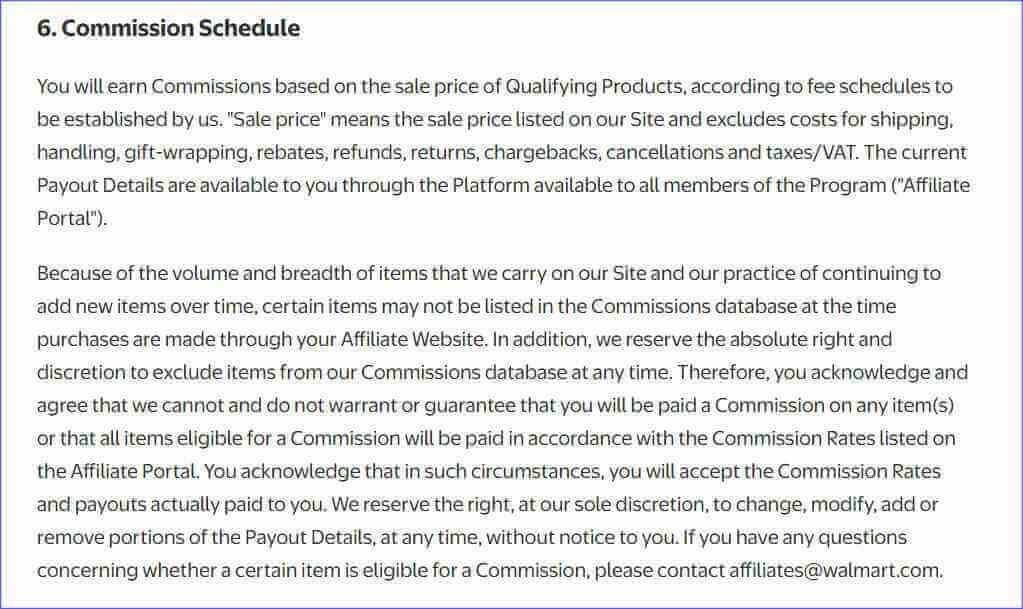
Besides that, you need to specify in your affiliate marketing agreement which payment methods you’ll use. Popular options include PayPal, direct deposit, check, or crypto. Remember to mention any fees that might be deducted from payments and who will be responsible for them.
To learn more, check this post on contract payment terms.
Cookie duration and attribution
Cookie duration refers to how long after a visitor clicks an affiliate link that you’ll attribute sales to that affiliate. This important technical detail can significantly impact your affiliates’ earnings.
For example, if you set a 30-day cookie, any purchase made within 30 days after someone clicks an affiliate link will earn a commission for that affiliate.
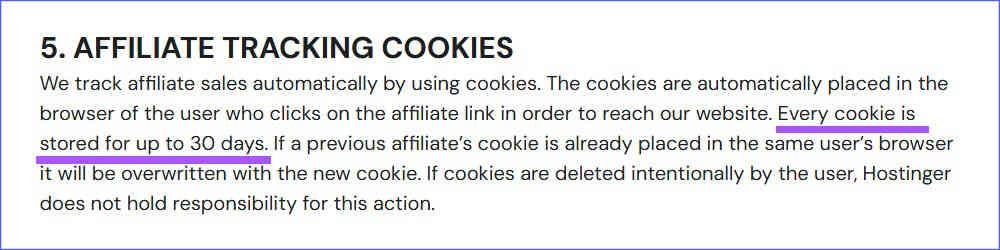
Shorter durations (like 24 hours) favor you as the merchant, while longer durations (60-90 days) benefit affiliates.
Also, address how you’ll handle attribution when multiple affiliates are involved. Clarify in your affiliate marketing contract if you will use first-click, last-click, or some other attribution model.
Promotional guidelines and restrictions
To protect your brand, include clear rules about how affiliates can and cannot promote your products. Specify which marketing channels are allowed (email, social media, blogs, paid ads) and which are forbidden.
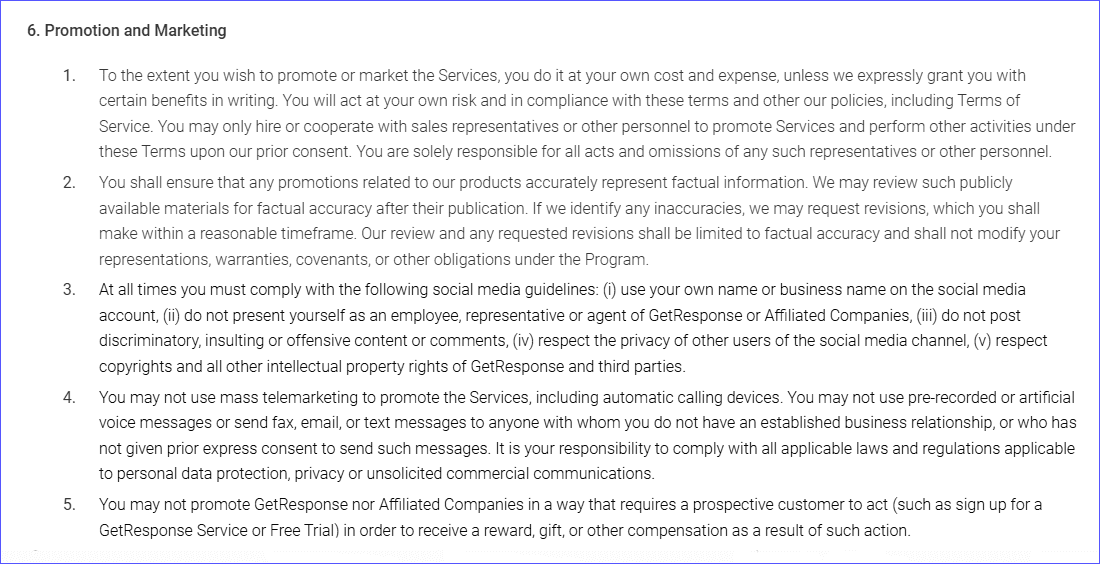
Here’s how you might phrase a restriction: “Affiliate may not bid on Merchant’s trademark terms in search engine marketing campaigns.” Having this in your affiliate marketing agreement prevents affiliates from competing with your own paid search efforts.
Also, outline any prohibited promotional tactics, such as spam, misleading claims, or adult content. Be specific about what constitutes appropriate representation of your products or services.
For more details, read this post on the enforcement of brand guidelines in affiliate contracts.
Termination clauses
All good things must come to an end, including some affiliate relationships. Include terms that explain how either party can end the affiliate marketing contract and what happens after termination.
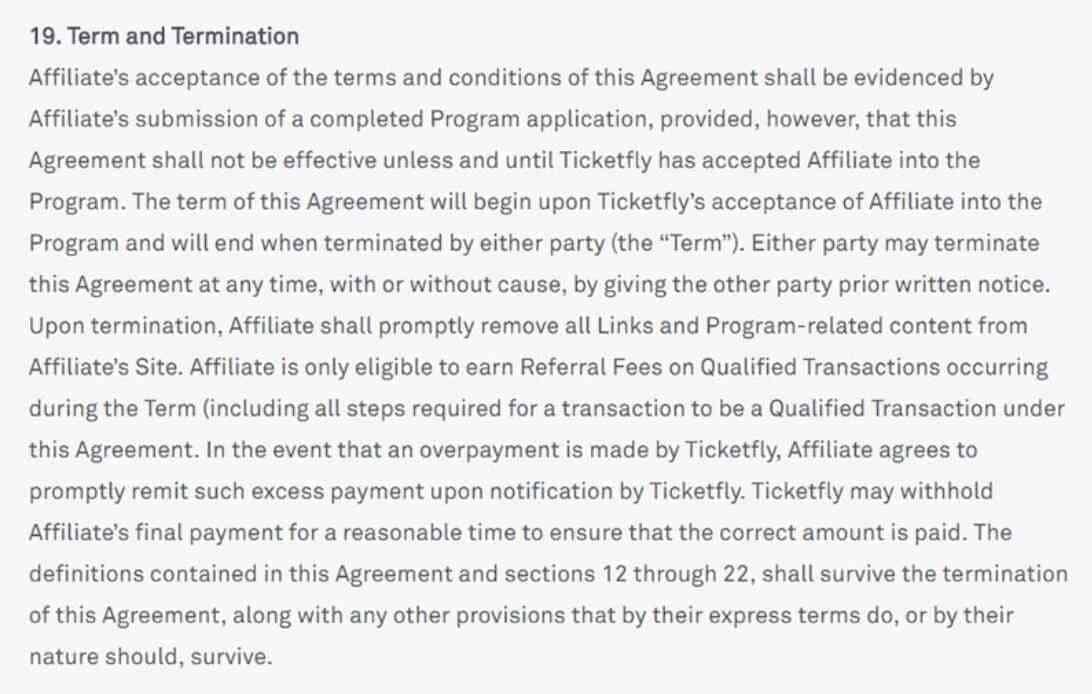
For instance, your affiliate marketing agreement might state: “Either party may terminate this agreement with 30 days’ written notice. Upon termination, Affiliate must remove all Merchant links and creative materials from their websites and marketing channels.”
Address whether affiliates will still receive commissions for sales that occur after termination but originated from their pre-termination marketing efforts.
To learn more, read this guide on the termination clause in contracts.
Confidentiality and non-disclosure provisions
You’ll likely share proprietary information with your affiliates, such as conversion data, marketing strategies, or upcoming product launches. Include provisions that require them to keep this information confidential.
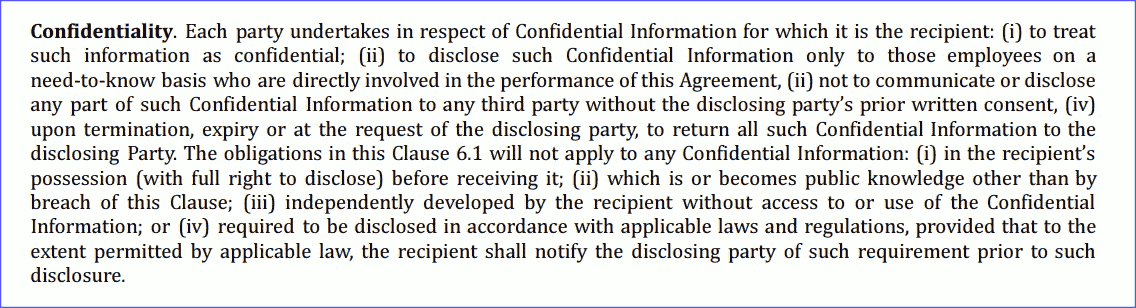
Similarly, prevent them from sharing your affiliate program details, such as commission rates or promotional materials, with competitors or other third parties.
Legal compliance requirements
Include sections requiring affiliates to comply with relevant laws and regulations. This is particularly important for rules around disclosure of affiliate relationships.
For example, in the US, the Federal Trade Commission requires clear disclosure of affiliate relationships.
Your affiliate marketing contract should state: “Affiliate must clearly disclose their relationship with Merchant in all promotional content in accordance with FTC guidelines.”
To learn more, check out this post on confidentiality and nondisclosure agreements.
By including these essential elements in your affiliate marketing agreement, you create a solid foundation for successful partnerships. A well-drafted agreement protects both parties and sets clear expectations from the start.
Affiliate marketing contract template
When starting an affiliate program, you need a solid affiliate marketing contract that protects both you and your affiliates. Using a template saves you time and helps ensure you don’t miss important details.
But remember that while templates provide a good starting point, you should customize them to fit your specific business needs and have them reviewed by a legal professional.
With that in mind, here’s a template you can begin with.
AFFILIATE MARKETING AGREEMENT
This Affiliate Marketing Agreement (“Agreement”) is made effective as of [DATE] by and between:
[COMPANY NAME], with its principal place of business at [COMPANY ADDRESS] (“Company”)
and
[AFFILIATE NAME], with an address at [AFFILIATE ADDRESS] (“Affiliate”).
1. Appointment
Company appoints Affiliate as a non-exclusive marketing affiliate to promote and market Company’s products and/or services according to the terms and conditions of this Agreement.
2. Term
This Agreement begins on the effective date stated above and continues until terminated as provided in Section 9.
3. Commission structure
3.1 Company will pay Affiliate a commission of [X%] on each qualifying sale generated through Affiliate’s unique tracking links.
3.2 A “qualifying sale” means a completed purchase of Company’s products or services by a customer who accesses Company’s website through Affiliate’s tracking link.
3.3 Commissions will not be paid on sales that are later refunded, charged back, or canceled.
4. Payment terms
4.1 Company will calculate commissions at the end of each calendar month.
4.2 Payments will be issued by the 15th day of the following month for all commissions exceeding $[MINIMUM AMOUNT].
4.3 If monthly commissions are below the minimum amount, they will carry forward to the next payment period.
4.4 Payments will be made via [PAYMENT METHOD(S)].
5. Tracking and reporting
5.1 Company will provide Affiliate with unique tracking links and access to a reporting dashboard.
5.2 Reports will show clicks, conversions, and commission amounts.
5.3 Affiliate must use the provided tracking links in all promotions to ensure proper commission tracking.
6. Affiliate obligations
6.1 Affiliate will use best efforts to promote Company’s products through their website, social media, email lists, or other approved marketing channels.
6.2 Affiliate must clearly disclose their affiliate relationship with Company in all promotional content.
6.3 Affiliate will not engage in any deceptive, misleading, illegal, or unethical practices.
6.4 Affiliate will not bid on Company’s trademark terms in paid search campaigns unless specifically authorized in writing.
7. Promotional restrictions
7.1 Affiliate shall not use spam, pop-ups, adware, spyware, or similar intrusive marketing methods.
7.2 Affiliate shall not make false or misleading claims about Company’s products or services.
7.3 Affiliate shall not promote Company’s products on websites containing adult content, hate speech, violence, illegal activities, or excessive profanity.
8. Intellectual property
8.1 Company grants Affiliate a limited, non-exclusive license to use Company’s trademarks, logos, and marketing materials solely for promoting Company’s products under this Agreement.
8.2 Affiliate shall not modify Company’s materials without prior written approval.
9. Termination
9.1 Either party may terminate this Agreement with 30 days written notice.
9.2 Company may terminate immediately if Affiliate violates any terms of this Agreement.
9.3 Upon termination, Affiliate must remove all Company links and promotional materials from their websites and marketing channels.
9.4 Commissions earned prior to termination will be paid according to the payment schedule in Section 4.
10. Confidentiality
Affiliate agrees to keep confidential all information provided by Company, including commission rates, marketing strategies, and customer data.
11. Modification
Company reserves the right to modify any terms of this Agreement with 14 days notice to Affiliate. Continued participation after notification constitutes acceptance of new terms.
12. Independent contractor
Affiliate is an independent contractor and not an employee, partner, or agent of Company.
13. Governing law
This Agreement shall be governed by the laws of [STATE/COUNTRY].
14. Entire agreement
This Agreement constitutes the entire understanding between the parties and supersedes all prior agreements or understandings.
IN WITNESS WHEREOF, the parties have executed this Agreement as of the date first above written.
COMPANY:
[COMPANY NAME]
By: [NAME]
Title: [TITLE]
AFFILIATE:
[AFFILIATE NAME]
Final thoughts on affiliate marketing agreements
A well-crafted affiliate marketing agreement protects both you and your business partners. By clearly spelling out commission rates, payment terms, and promotional guidelines, you avoid misunderstandings that could damage relationships or hurt profits.
Remember that this legal document serves as your roadmap for successful partnerships. Take time to customize your agreement to fit your specific business needs rather than using a generic template without modifications.
Review your affiliate agreements regularly as your business grows and marketing practices evolve. What works for your company today might need adjustments next year.
If you’re unsure about any legal aspects, consult with an attorney who specializes in affiliate marketing contracts. The money spent on proper legal advice is a small investment compared to the potential costs of disputes or compliance issues down the road.
Did I miss anything? Did you try these tips? Do you have any questions or comments? Share your thoughts below in the comments section.