
Think about Coca-Cola for a moment. You’d probably recognize their logo even without the red color — just from the swooping script alone. That’s the power of a well-chosen brand font.
The typeface you pick for your business does more than display words. It sends signals about who you are before anyone reads a single sentence. Some fonts feel trustworthy, others feel playful, and some just feel off.
But how do you find the right one for your brand? And what makes certain fonts work while others fall flat?
I picked logo, headline, and body text typography recently for a new brand that I am launching. So I wanted to revisit this subject and share what I know.
In this guide, you’ll learn how fonts shape perception, how to choose brand typography that fits your business’s personality, and common mistakes to avoid along the way.
Disclaimer: If you buy any products through links on this site, I may earn a commission. But it doesn't make any difference to your cost, and it helps me keep this blog running. So you could always read my articles for free.
What is brand typography?
Let’s start with the basics. Before you pick fonts for your brand, you need to understand what brand typography actually means and why it matters.
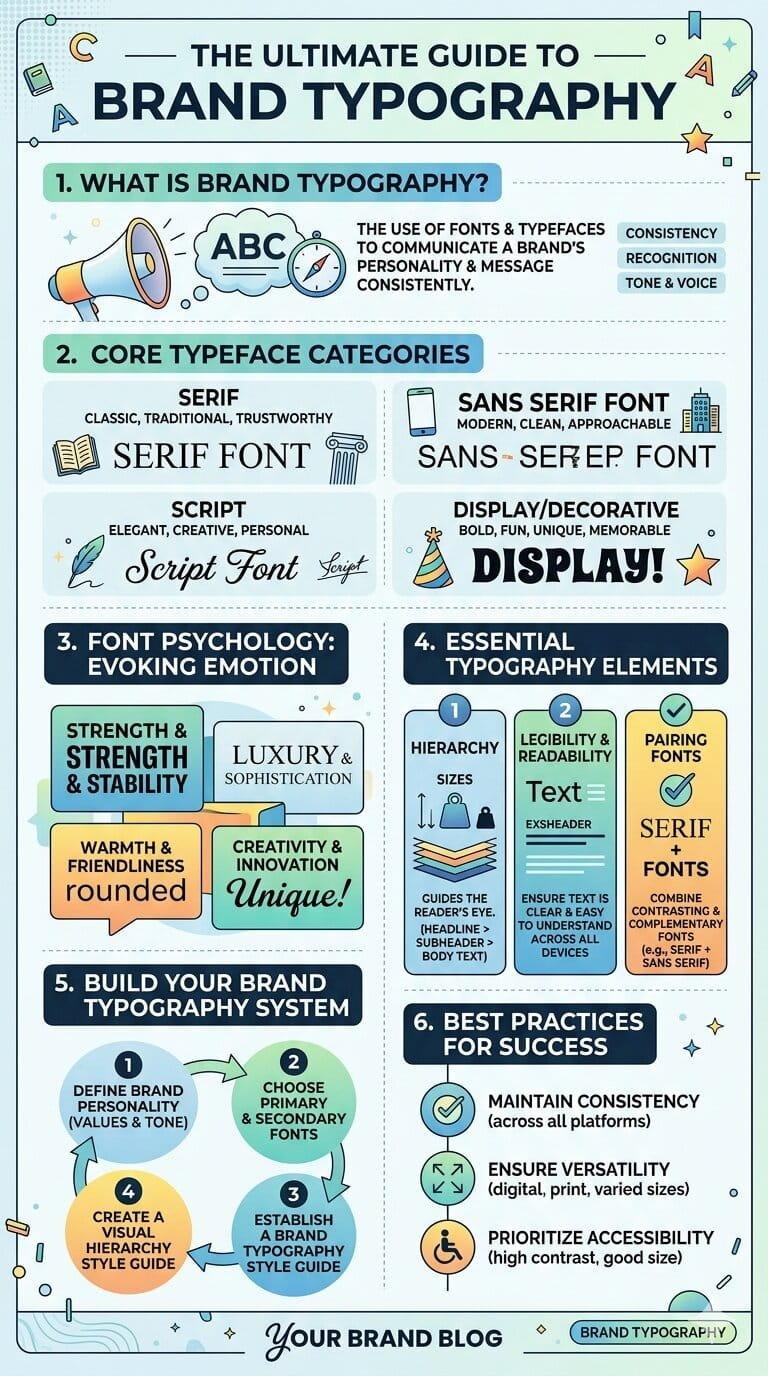
Brand typography refers to the specific fonts and typefaces you use across all your brand materials. This includes your logo, website, packaging, social media posts, emails, and print materials. In short, anywhere your brand shows up in written form.
But here’s the deal. It’s not just about picking a font that looks nice. Brand typography is a system. It usually includes a primary font for headlines, a secondary font for body text, and sometimes a third font for accents or special uses. These fonts work together to create a consistent visual language.
Think of it like your brand’s handwriting. Just as you can recognize a friend’s handwriting on a note, your audience should eventually recognize your business’ typography without seeing your logo.
And you know what? Typography does a lot of heavy lifting behind the scenes. It affects readability, sets the mood, and shapes how people feel about your brand before they even process the words.
A law firm using a playful comic-style brand font would feel strange, right? That’s because fonts carry meaning.
The bottom line is that brand typography gives your business a distinct visual voice. When done right, it reinforces your brand identity and builds recognition over time. When done poorly, it confuses your audience or sends the wrong message entirely.
Why choose brand fonts?
So why should you spend time choosing specific fonts for your brand? Can’t you just use whatever looks decent? Let’s look at the real reasons brand fonts matter.
They build recognition
First of all, consistent typography helps people remember you. When you use the same fonts everywhere—your website, business cards, social media, and packaging—you create visual patterns. Over time, your audience starts associating those fonts with your brand. It’s subtle, but it works.
They communicate personality
Fonts speak before words do. A bold, geometric font says something different than a delicate script. For example, a children’s toy company and a financial consulting firm shouldn’t use the same typography for their brand. Your font choice tells people what kind of brand you are within seconds.
They improve readability
Here’s the deal—if people struggle to read your content, they leave. The right brand fonts make your website, emails, and marketing materials easy to scan and digest. This matters especially for body text where people spend most of their reading time.
They create professionalism
Let’s face it—random font choices look sloppy. When your Instagram post uses one font, your website uses another, and your email signature uses a third, it feels disjointed. Consistent brand typography signals that you pay attention to details and take your business seriously.
They set you apart
There’s more to it than just looking polished. Your typography can help differentiate you from competitors. If everyone in your industry uses safe, corporate fonts, a distinctive typeface can make you stand out and feel fresh.
In short, brand fonts aren’t decorative extras. They’re functional tools that shape perception, improve user experience, and strengthen your overall brand identity.
Types of fonts
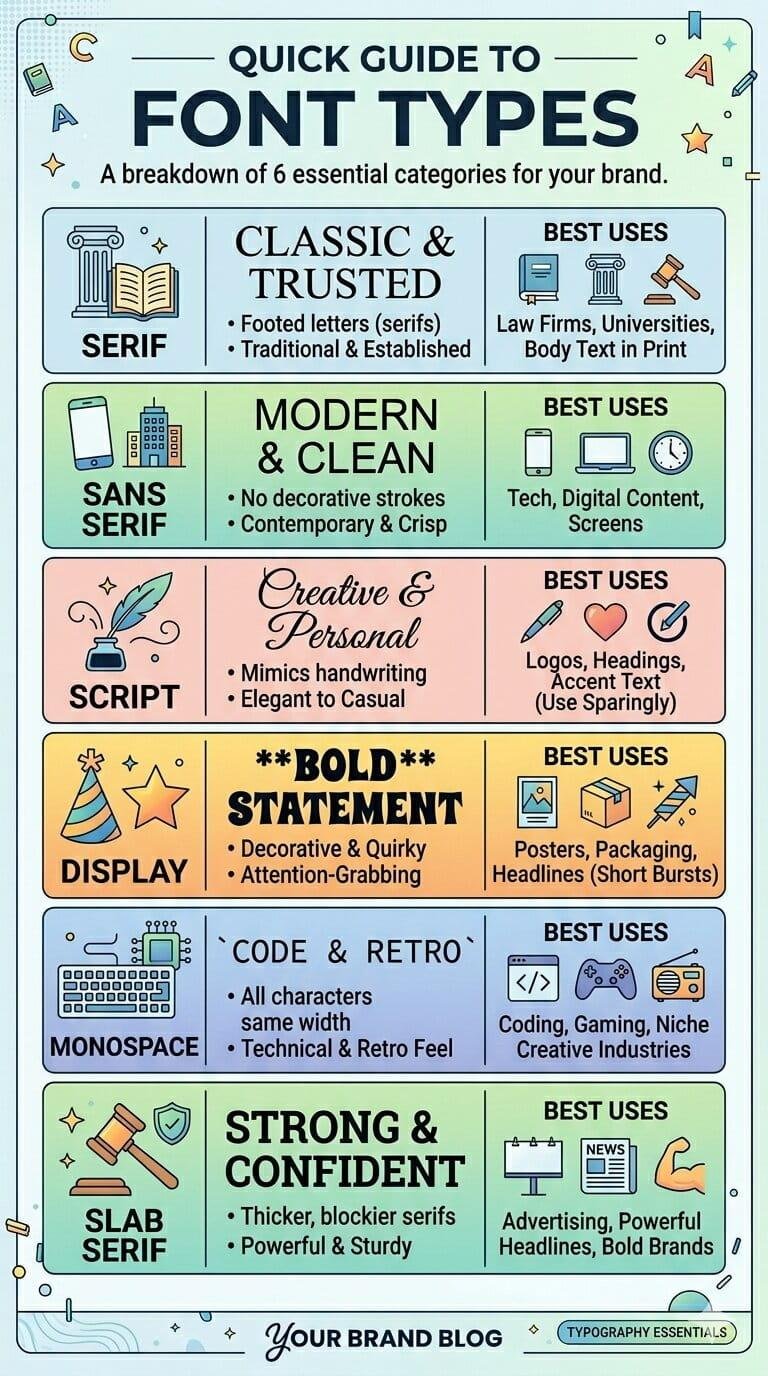
Before you pick fonts for your brand, you need to know what’s out there. Fonts fall into several categories, each with its own look, feel, and best uses. Here’s a breakdown of the main types.
Serif fonts
Serif fonts have small lines or strokes attached to the ends of letters. Think of the little feet at the bottom of letters in Times New Roman. These fonts feel traditional, trustworthy, and established. You’ll often see them used by law firms, newspapers, universities, and luxury brands.
For example, fonts like Georgia, Garamond, and Baskerville fall into this category. When it comes to brand typography, serifs work well for body text in print materials because they help guide the eye from letter to letter.
Sans serif fonts
Sans means “without” in French. So sans serif fonts don’t have those small decorative strokes. The result? A cleaner, more modern appearance. Fonts like Arial, Helvetica, and Open Sans belong here.
These fonts feel contemporary and straightforward. They’re popular for digital content because they stay crisp and readable on screens of all sizes. When choosing brand fonts, tech companies, startups, and modern brands often lean toward sans serif typography.
Script fonts
Script fonts mimic handwriting or calligraphy. They range from elegant and formal to casual and playful. Think of fonts like Pacifico, Great Vibes, or Lobster.
Here’s the deal—script fonts add personality and flair, but they come with a catch. They’re harder to read in long blocks of text. So if you choose script fonts as typography for your brand, you’ll want to use them sparingly, usually for logos, headings, or accent text rather than paragraphs.
Display fonts
Display fonts are designed to grab attention. They’re bold, decorative, and often quirky. You’ll find them on posters, packaging, and headlines where impact matters more than readability.
The only problem? They don’t work for body text. Their elaborate designs make them exhausting to read in large amounts. Use them for short bursts of text where you want to make a statement.
Monospace fonts
In monospace fonts, every character takes up the same width. The letter “i” gets the same space as the letter “m.” Courier is a classic example.
These fonts have a typewriter or coding feel. Businesses in tech, gaming, or creative industries sometimes use them as brand fonts to convey a technical or retro vibe. That said, they’re a niche choice and won’t suit every brand.
Slab serif fonts
Slab serifs are like serif fonts but with thicker, blockier strokes. Fonts like Rockwell and Roboto Slab fit this category. They feel sturdy, confident, and slightly industrial.
They are a good choice of fonts for brands that want a bold presence without going fully modern. You’ll see them in advertising, headlines, and brands that want to feel strong but approachable.
In short, each font type carries its own personality. Understanding these categories helps you narrow down which style aligns with your brand before you dive into specific font choices.
Steps to pick your brand’s typography
Now that you understand font types, let’s get practical. Picking typography for a brand isn’t about scrolling through fonts until something catches your eye. It’s a deliberate process that connects your visual identity to your brand’s core. Here’s how to approach it step by step.
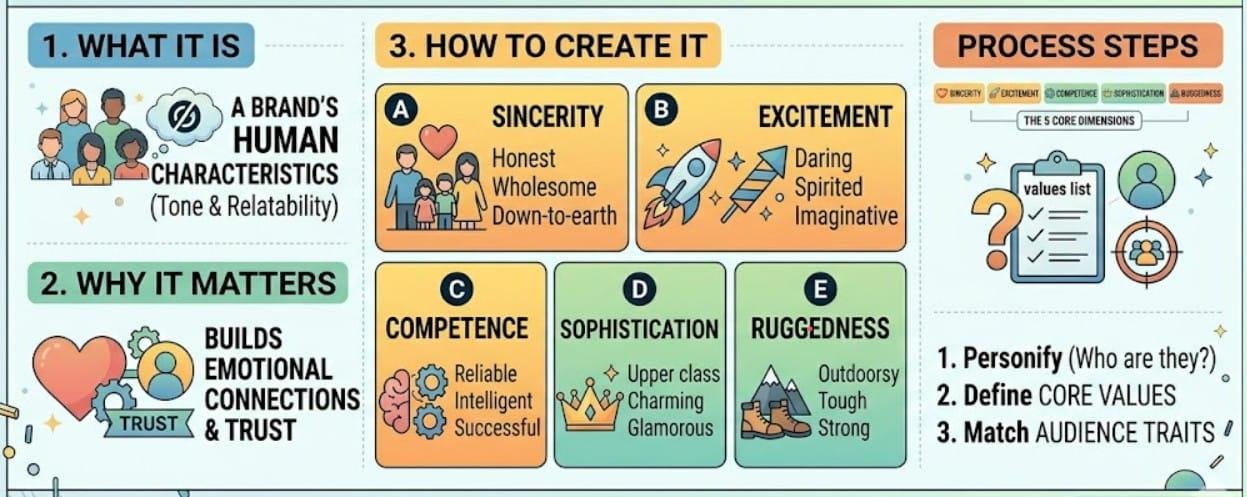
Define your brand personality
First of all, you need clarity on who your brand is. Before looking at a single font, write down three to five words that describe your brand’s personality. Are you playful or serious? Traditional or modern? Luxurious or budget-friendly? Bold or subtle?
For example, a children’s educational app might use words like fun, friendly, and approachable. A wealth management firm might choose words like trustworthy, sophisticated, and stable. These personality traits will guide every typography decision you make.
Here’s the deal—if you skip this step, you’ll end up choosing brand fonts based on personal preference rather than strategic fit. And your personal taste might not match what your target audience expects or responds to.
Research your audience
Your fonts need to resonate with the people you’re trying to reach. So, while selecting typography for your brand, take the time to understand your audience’s expectations and preferences.
Consider their age, industry, and cultural background. A font that appeals to Gen Z consumers might feel out of place for retirees. Similarly, what works for a creative agency audience won’t necessarily work for a healthcare audience.
Also, look at what your audience is already familiar with. If you’re in a traditional industry, straying too far from expected typography might confuse people or make your brand seem unprofessional. On the other hand, if you’re in a creative field, playing it too safe might make you forgettable.
For more details, check out my post on analyzing and defining your audience.
Study your competitors
Next, see what others in your space are doing. This isn’t about copying anyone’s brand typography—it’s about understanding the landscape and finding opportunities to stand out.
Look at five to ten competitors and note their font choices. Do you see patterns? Maybe everyone uses clean sans serif fonts. Or perhaps serif fonts dominate your industry.
The result? You’ll know what’s expected and where there’s room to differentiate. If the brand fonts of all of your competitors look the same, a thoughtful departure from the norm could help you get noticed. But if there’s a good reason everyone uses similar typography, going against the grain might backfire.
To know more, read this article on how to conduct a visual identity competitor audit.
Choose a primary font
Now you’re ready to start selecting fonts. Your primary font is the workhorse of your brand typography. It’s what you’ll use most often—typically for headlines, titles, and key messaging.
This font should strongly reflect your brand personality. If you described your brand as bold and modern, look for a sans serif with strong geometric shapes. If your brand is elegant and refined, consider a classic serif with delicate details.
Test your options by typing out your brand name and a few headlines. See how they look at different sizes. A font that looks great large might lose its impact when scaled down.
The way I like to do this is by creating a couple of graphics using a simple tool like Canva. It could be a brochure, a cover, or anything that includes a headline and a chunk of body text.
I pick a template that I find the closest to what I have in mind for my brand. Next, I start editing the template and experimenting with different fonts. If none of the available fonts are cutting it for me, I also look for new fonts on platforms such as DaFont and Google Fonts.
Then I download the fonts I like from these websites and upload them on Canva to keep experiments on the graphic I was working on.
Select a secondary font
Your secondary font supports the primary font for your brand. It’s usually used for body text, longer content, and supporting information.
Here’s where readability becomes critical. When selecting the secondary font for your brand typography, you need to make sure it is easy on the eyes, even in small sizes and long paragraphs. Fancy or decorative fonts won’t work here.
That’s not all—your secondary font also needs to pair well with your primary font. The two should complement each other without competing for attention. A common approach is pairing a serif with a sans serif, but fonts within the same category can also work if they have enough contrast.
Test the pairing
Don’t commit to your fonts until you’ve tested them together in real scenarios. Create mockups of your website, social media posts, business cards, and any other materials you regularly produce.
Ask yourself some questions. Do the brand fonts work together visually? Is the body text easy to read? Do the headlines grab attention without overwhelming the page? Does the overall look match your brand personality?
There are many great tools you can use to discover and test new font pairing and combinations. My favorites include Fontjoy and Fontpair.
I also like to show the graphics I created with my shortlisted font choices to others for a second opinion. And to ask an AI agent like Claude or ChatGPT to analyze it considering the brand this is meant for.
Also, test the typography for your brand on different devices. A font that looks crisp on your desktop might blur or feel cramped on mobile screens. Since most people browse on their phones, mobile readability is essential.
Check practical requirements
Before finalizing your choices, make sure your brand fonts meet practical needs. First, consider licensing. Some fonts are free for commercial use, while others require purchased licenses. Using a font without proper licensing can lead to legal issues down the road.
Next, check for web compatibility. If a font doesn’t load properly on websites, you’ll need a fallback option. Google Fonts and Adobe Fonts offer large libraries with reliable web performance.
Also, look at language support. If your brand operates internationally, your fonts need to include characters for all the languages you use.
Document your typography guidelines
Finally, create a simple guide that outlines your brand typography rules. This keeps your brand consistent, especially as your team grows or you work with outside designers.
Include your primary and secondary fonts, when to use each, acceptable sizes, spacing guidelines, and any fonts to avoid. The more specific you are, the less room there is for inconsistency.
I find using AI really helpful at this stage. Once I have worked out my brand font pairing and usage on real graphics, I feed that information to AI and prompt it to generate font guidelines for this brand. Then I make adjustments to those guidelines as required.
Final thoughts on brand fonts
Picking brand typography takes research, testing, and thoughtful decision-making. But when you follow a structured process, you end up with fonts that look good, function well, and truly represent your brand.
Did I miss anything? Did you try these tips to choose fonts for your brand? Do you have any questions or comments? Share your thoughts below in the comments section.